Thursday, 13 November 2014

More Maladroit than Malmaison


Promoting construction 2014

The airwaves and twittersphere have been buzzing this month, in reaction to construction hoardings around Manchester’s Malmaison Hotel emblazoned with a scantily clad woman showing her cleavage and fondling an electric drill. 

The immediate reaction of one well-known guest at the hotel was to write to a national newspaper. Jeanette Winterson, author and a professor of creative writing at Manchester University, wrote in the  Guardian, "Women at work seems to mean wearing a strapless dress and full makeup while staring longingly at a drill that presumably doubles as a vibrator."

On BBC News, Kate Lloyd of the Construction Industry Training Board (CITB) bemoaned the blatant sexual stereotyping of the industry and talked about how the organization has for years been trying to encourage females of all ages to consider careers in the sector. 

CITB's model in The Sun 2008
Indeed. Readers of this blog may recall a story I posted in 2008  highlighting  a CITB recruitment campaign costing £500,000 designed to attract more young people into construction. One poster featured a young woman cheekily sporting a hard hat, showing her cleavage and clutching an electric drill. See Phwoar what a corker. 

But let's move on. Becca Warren, a civil engineer with Sinclair Knight Merz, took a rather more inclusive and pro-active approach to the issue than the CITB. She started a lively discussion on the LinkedIn group for WIBSE (Women in Building Services Engineering). She then put words in action by taking a  group of people to the Malmaison Hotel  to raise the matter with management and to hand over letters of complaint - including one signed by 20 Manchester councillors. 

Becca reports that the manager, a woman, appeared to fail completely to understand the issue but accepted their points and said she would raise them with head office. Best not to dwell on the Malmaison manager's comment that the image was meant to be "tongue in cheek."

Congratulations to Becca and WIBSE for responding so quickly. Other organisations in the construction and property industry are also now picking up the issue. Meanwhile, I am reminded of a very different approach to decorative site hoardings I spotted earlier this year.  Real men and women,  professional and skilled, engaged in the building and conservation works at  glorious Lincoln Cathedral. The words sacred and profane come to mind.

Lifting the spirits at Lincoln Cathedral


Friday, 31 October 2014

Going South - Madrid to Santiago


Madrid Airport’s Terminal 4 is a vast arching space with undulating, louvred panels floating wave-like above us, supported by golden yellow pillars. We feel not only rather small, but also a little lonely. In this vast space, there seem to be few fellow travellers – a sobering reminder of the monumental collapse of the Spanish economy. With a three hour wait until our connection to Santiago, Chile, we find a small, quiet restaurant. Wine is served only by the glass, rather than by carafe or bottle, but there is seemingly no limit on the number of glasses. Our order gets a little lost in translation, despite our best Spanish. Red wine instead of white, fish soup forgotten, but all is friendly and eventually sorted.

I'm sure I said blanco, not tinto...
I muse over who designed this cathedral to the art of flight. Calatrava perhaps, that Spanish magician who combines architecture and engineering to create wonderful soaring and delicate churches, museums, bridges, railway stations and airport buildings? But how could I have forgotten that it was Richard Rogers working with Spain's Antonio Lamela, the project winning them the 2006 Stirling Prize,  and Carillion's TPS winning the Institution of Structural Engineers prize for Commercial Structures the same year.

At the departure gate, there are suddenly crowds of people, including a group of young men and women in bright red football strip. We learn that they are Team England, who are competing in the Homeless Football World Cup taking place in Santiago next week.  We chat to Gareth Parker, the charming chap in charge of the group who tells us that HomelessFA has been running for about five years in various cities in the UK, and is using football to help young people find a sense of purpose, teamwork, transferable skills etc. He is delighted that the charity has just gone into partnership with CentrePoint, which opens up more possibilities to change the lives of homeless young people through sport.

Team England in their strip for the Homeless Football World Cup in Chile
On boarding, we discover that despite consulting Iberia's seat plan and the oracle SeatGuru, the exit row for which I paid extra to ensure legroom is not an exit row at all. As I speak to the steward, in an effort to switch seats, a young Spanish businessman turns up to take the third of the four seats in the row and is as dismayed as we are. He too consulted SeatGuru to ensure an exit seat, he tells the steward. The steward promises to sort something, and sure enough returns in five minutes, spirits the young man off to an empty two seat row and tells us that we can have the whole four seat row to ourselves. We take off on time, at 20 minutes past midnight and not long afterwards, the cabin is darkened and most people try to sleep. Small baby close by is wakeful, but easily soothed. Unlike the two guys in the (real) exit row in front of the child, who snuffle, sneeze loudly and clear their throats exuberantly throughout the night.

Flying over the Andes
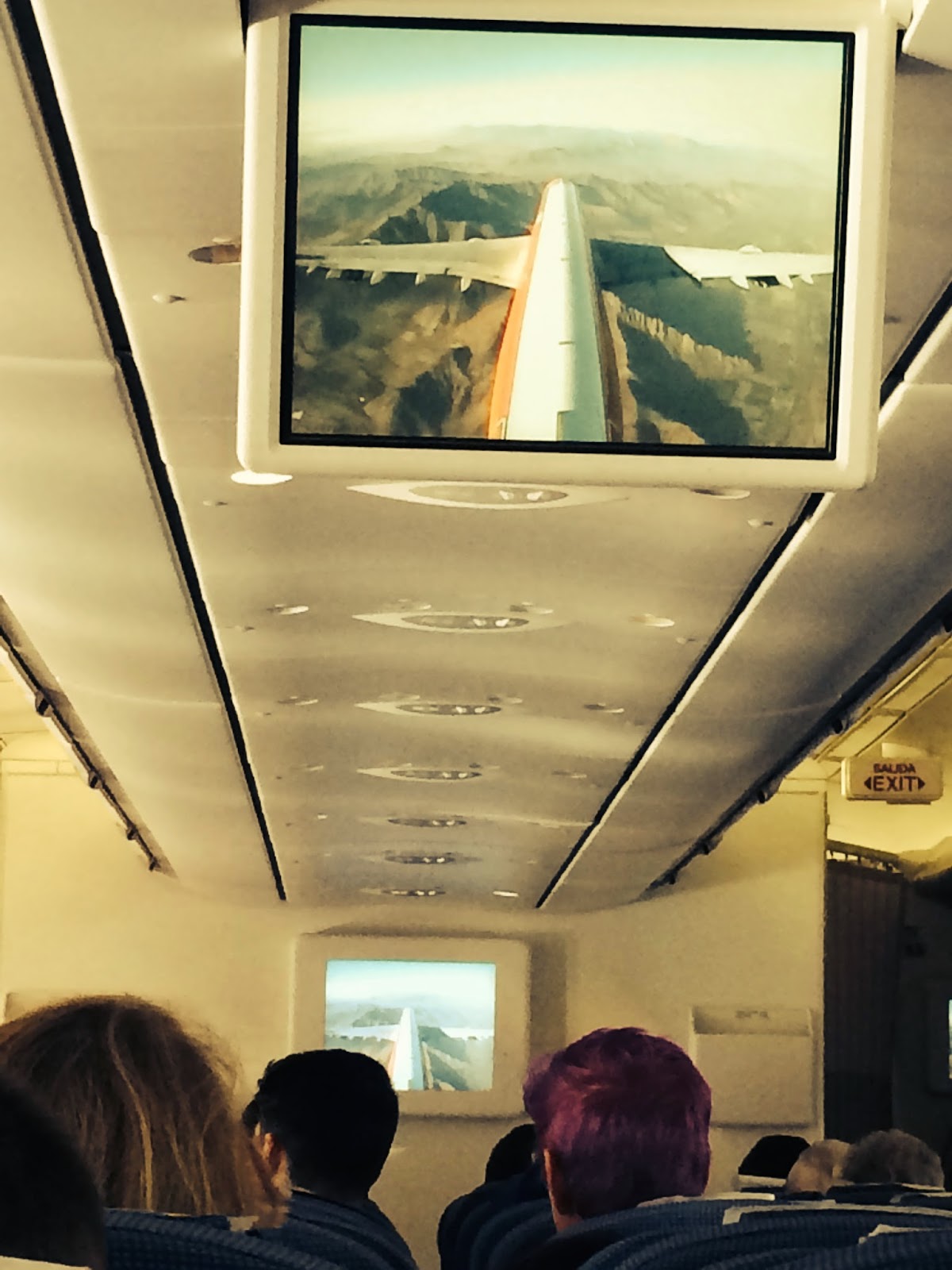
Some 12 hours after leaving Madrid, breakfast is served and the aisles are filled with stretching, weary passengers. Then we realise that the central screens are showing real time film of our approach to Santiago. The Andes appear through snow and mist and ice crystals on the camera lens. Captivated, we watch as the peaks slowly come into view, their majestic, sharp ridges glowing in old rose and burnt siena in front of our eyes. Convincing us that we are indeed having a reality tv experience, the undercarriage comes down, roads, buildings and then the runway come into view. Puffs of white smoke appear as we touch down, the retro thrusters kick in and we begin a slow, graceful progress towards the terminal building.  Passengers break into applause, from enjoyment of the spectacle rather than relief at a safe landing.

Santiago is a stopover en route to our final destination, Stanley in the Falkland Islands – the gateway to the Antarctic. The purpose of the trip is to supervise the construction of the foundation for the memorial to those who lost their lives working in British Antarctic Territory and to make detailed plans for its dedication in February 2015. (See British Antarctic Monument Trust). The bronze and polished steel memorial is itself on its way to Stanley, on board the British Antarctic Survey ship James Clark Ross. 
Finishing touches in the Pangolin foundry before shipping
Our spirits rise when our luggage appears on the conveyor belt intact. The five threaded steel rods, each 500cm long and 16mm diameter, protected by pipe insulation and packed amongst socks, sweaters and shirts, did not set off alarms bells going through security. So it seems we will be able to achieve a key task in the project, embedding the bolts in concrete ready to receive and secure the memorial in its windswept position on Dockyard Point, its tip shining towards the Harbour Narrows. 

Postscript: the women's team taking part in the Homeless Football World Cup had only been playing together for a few days before setting off for Santiago, yet reached the quarter finals before losing to Mexico. The men's team reached the final eight for the first time since joining the competition. Many congratulations to all.

Sunday, 23 March 2014

Kiev, Kismet and Kulchur Klash

 Maidens,  music and 12,500 silk poppies                   Cory Weaver, Metropolitan Opera   
We're off to the cinema this afternoon, with champagne, smoked salmon sandwiches and 80% dark chocolate to sustain us for four and a quarter hours of Russian opera, direct from New York. The best thing to happen in the arts for years,  Live from the Met  is a brilliant way to enjoy opera and at £29  (for a view that would set you back $300 dollars or more in the house),  you can even risk trying something unknown.

Not that Borodin's music for his epic opera Prince Igor could be described as unfamiliar. Much of the score was immortalised in the 1953 Broadway musical Kismet, and the Polotsvian Dances were used at the opening ceremony of this year's Winter Olympics at Sochi. Nevertheless, it is ninety seven years since the opera itself was last performed at the Metropolitan Opera House and Borodin himself never saw it performed, as despite working away at it for 20 years, he had not finished it (like most of his music) when he died in 1887.

It was his friends Nikolai Rimsky-Korsakov, Anatol Liadov and Alexander Glazunov who completed Prince Igor, Glazunov writing the overture entirely from the memory of hearing Borodin play it. Based on the only surviving manuscript of a mediaeval poem, the  libretto for the new Met production uses the 1960s  translation by the novellist Vladimir Nabukov (of Lolita fame). The story tells of a Russian Prince ruling the ancient Ukrainian city state of Putivl who sets out to fight the Polotsvians,  nomadic warriors from Mongolia (an interesting thought for an audience conscious of the rising tensions in Kiev and the Crimea).

Despite the advice of the boyars and an ominous eclipse of the sun,  Prince Igor sets out with his army, leaving the city in the charge of his wife Yaroslavna's brother Galitsky, who turns out to be a thoroughly nasty piece of work, having his way with any maiden who takes his fancy, plotting to send his sister to a nunnery and intent on taking over the throne.

After the battle                                           Victor Vasnetkov, Tretyakov Gallery, Moscow
Meanwhile Prince Igor's army is overwhelmed and he and his son Vladimir taken prisoner and the invaders go on to overrun Putivl. The victorious  Khan treats his prisones with the respect and hospitality due to royal captives, but despite this (and the blandishments of the Polotsvian women) both manage to escape and return to find Putivl in ruins. The good news is that the traitorous Galitsky was killed by the invading Polotsvians but his wife Yaroslavna is alive. Filled with remorse for his failed campaign, Prince Igor asks his citizens for forgiveness and leads them in rebuilding the city.

Back to Borodin and the unfinished works. As well as a musician (he could play the piano, flute, violin and cello) he was a linguist (he could speak French, German and Italian as well as his native Russian) but far from being an anguished artist sitting up for night after night struggling to complete a score, he described himself as a 'Sunday musician', preferring to focus his time on his career as an outstanding organic chemist (some believing that he was first to link cholesterol to heart disease).


Not only a Renaissance man, combining the arts and sciences with equal skill, Borodin was a feminist.  Encouraged by his greatly loved wife Ekaterina, who was committed to women's rights, he believed in  equality of education. Convinced that women would make good doctors, he founded with Ivan Pavlov the St Petersburg Medical School for Women, running it for the last 12 years of his life.

He said, "As a composer seeking to remain anonymous, I am shy of confessing my musical activity... For others it is their chief business, the occupation and aim of life. For me it is a relaxation, a pastime which distracts me from my principal business, my professorship. I love my profession and my science. I love the Academy and my pupils, male and female, because to direct the work of young people, one must be close to them."

Despite this commitment, Borodin's monumental tomb at the Alexander Nevksy Cemetery in St Petersburg is a testament to his music. So it is comforting to know that on his burial casket there is a silver plate from his women students which reads: "To the Founder, Protector and Defender of the School of Medicine for Women."   Rather than his music, this was the project of which he was most proud.


Saturday, 1 February 2014

A la recherche du temps perdu

Mademoiselle de Paris

Paris, 45 years on .....
We arrive at the Gare du Nord on a crisp and sunny winter's day to celebrate our 45th wedding anniversary in Paris, the city where we inadvertently became embroiled in the dramatic events of May 1968 when the student riots escalated into civil unrest.  The taxi queues are long and the Metro heaving with luggage laden people, so we walk from the station to our hotel in the Ile St Louis. By the time we arrive, we really feel we are in Paris.  The Hotel Lutece is a charming, tall, narrow building in a street filled with shops, restaurants and galleries,  their windows sparkling for Christmas and all much smarter than when we last stayed there. Our spacious room is right at the top, with large windows overlooking rooftops, domes and spires. Unlike Lindsay Duncan in Le Weekend, we are very happy with our choice.

This evening we are invited to dinner by our Finnish friend Jorma and his French wife Sylviane who live in the 16th arrondissement. After celebratory champagne,  Jorma unveils a selection of wines from his formidable cellar,  chosen to relate to our wedding anniversary and beginning with a 1970 (the nearest he has to 1968), followed by 1978, 1988 and 1998. We are invited to choose which to drink with the saddle of boar (shot by Jorma in Fontainebleu Forest!) and which to drink with the cheese. On a higher culinary plane than madeleine cake - and certainly far more sophisticated than the food we enjoyed all those years ago -  the meal and companionship triggers a Proustian stream of reminiscence.

We share memories of being in Paris in May 1968 - the seriously scary riot police, the noise, the shutdown of banks, airports and railways, the general strike. We tell our tale of getting a Hertz car (by dint of our journalist accreditation and determination), taking two and a half hours to drive along the Champs Elysee and then setting off to Brussels via country roads, gambling that petrol would be more available than in the cities. We learn from Sylviane that we made the right decision - she too set out by car to escape the rioting city, but was forced to return because she could not find any service stations with fuel. Meanwhile we arrived in Brussels to find no seats on flights to London for days, so we drove on to Ostend to catch a ferry - we had jobs to hold down at a time when the economy was challenging.

And challenging it certainly was in the UK back in 1968. Harold Wilson was trying to increase British competitiveness by asking workers to do more without getting paid,  Enoch Powell was dismissed from the Cabinet after making his Rivers of Blood speech about the consequences of uncontrolled immigration. There were severe storms, killing seven people and resulting in The Great Flood which inundated large areas of the south east of England. Like Paris, the capital saw major unrest,when 91 policemen were injured and 200 people arrested in protests against the war in Vietnam, outside the US Embassy in Grosvenor Square. And more ominously, a civil rights march in Londonderry revealed the full spectre of sectarianism in Northern Ireland that triggered the events that resulted in The Troubles. Despite all this doom and gloom - or perhaps as an antidote - we decided to get married.

The Dagenham Ladies
And then I recall celebrating another significant event from 45 years ago, just a few weeks earlier in October 2013. In the Intercontinental Hotel ballroom,  surrounded by extraordinary individuals at the Women of the Year lunch, I join the huge applause for the winners of the Outstanding Achievement Award.  Up on to the stage go eight of the women who took part in the strikes for equal pay and recognition of skill that took place in 1968 at the Ford car plant in Dagenham, Essex.  Machinists Vera Sime (83), Eileen Pullen (84), Gwen Davis (81), Sheila Douglass (77), Dora Challingsworth (74), Pamela Brown (59), Sarah Kavia (60) and Bharti Patel (64). They won their battle - but the fight for equal pay for women is not over yet. Plus ca change.....


Sunday, 26 January 2014

Cocktales


Alex Katz, The Cocktail Party, 1965 


Conversation over New Year drinks with a chap from a global project management and cost consultancy company is wide-ranging and interesting. Dark matter,  opera, searching for the Higgs Boson certainly more than small talk.  Just as I finish recounting how an Italian scientist working at CERN suggests that the reason so many women in his country study physics is because it is seen as metaphysical or philosophical rather than mathematical, our host joins us. My fellow guest turns to him and says, "I thought the reason there are more women studying physics in Italy is because they have big t**s, but this lovely lady tells me that there is a different reason."
  

Struck dumb, I turn to our host, who shows no sign of embarrassment, and briefly repeat my explanation. Our companion carries on conversing in a normal manner and I shortly move away to talk to others, wondering if I imagined the crude remark. Some fifteen minutes later, I am engaged in conversation with a small group when he materialises again at my elbow.  Someone politely introduces me to him, when he responds  that of course he knows me - and that we have a love child together. 

We certainly do not, I snap, and leave shortly afterwards. I fulminate all the way home, wondering whether my failure to respond more forcefully was due to shock or simply a reluctance to be rude at an industry social event in a prestigious venue. This evening the ten o'clock news is full of ageing media personalities defending charges of sex abuse, and a major political figure denying allegations of inappropriate behaviour. Commentators question why women take time to bring these charges, women talk about the difficulty of being taken seriously, others ask what is so bad about a hand on the leg or a bit of lighthearted banter.


I know that misogyny is alive and well in the property sector and Spearmint Rhino remains a popular entertainment venue, but it is a long time since I experienced such behaviour. Did this Neanderthal think I would be flattered by his claim? How I should respond should such an incident happen again?  After a few hours calm reflection, I decide that the next time lighthearted banter indicates that a chap's brain has taken residence in his trousers, that is the place to empty my glass. Whoops....


Saturday, 14 December 2013

Time to call that spade a shovel


Image from National Portrait Gallery

Under the steely eye of Good Queen Bess, a crowd of property industry clients and consultants gather to hear about the launch of the DTZ Curzon Group at the National Portrait Gallery in London. An appropriate setting for an initiative to attract and retain more women in the sector, yet I can't help wondering how Elizabeth 1 - the monarch with the 'weak and feeble body of a woman but the heart and stomach of a king' - would have regarded the need for such an event half a millennium after she had ruled a country for so long. 

But then as Colin Wilson, head of DTZ in the UK and Ireland says in his address, for organisations like his who can trace their origins back a few hundred years, "it is difficult to judge the point at which things like this need to change  - largely because that is the way it has always been."  So the DTZ initiative is welcome, particularly as the plan is to roll it out throughout the EMEA region. 

Interestingly, as 2013 draws to a close, the DTZ event is one of a veritable flurry looking at attracting and keeping more women in engineering, construction and property. Listening to the familiar litany of problems, proposals for more research, earnest statements about fishing in only half the pool, I raise my metaphorical hat yet again to the campaigners who repeat their storytelling with new minted, smiling freshness.  But it seems that the demographic and economic arguments have finally got through, not to mention that whilst the UK slides down the global table when it comes to the number of young people studying science and engineering, the relatively few girls tackling these subjects achieve higher grades than the boys. 

Student Award finalists 2013,  run by the Association of Women in Property

However there is an interesting dichotomy appearing. We might have moved from a culture of avoiding putting gender on the agenda to a cry of 'please tell us how to resolve it' but there is still quite a degree of wriggling when it comes to terminology. Colin Wilson confesses to being uncomfortable with words like gender or ethnicity, preferring to talk about people. 

The language  issue arises again the following week when the redoubtable Dorte Rich Jorgensen hosts a CIC Constructive Diversity event at the Building Centre. We hear Kate Lloyd of the CITB telling us how difficult it is to attract women (generating heated interventions about the loss of successful training organisations such as Women's Education in Building) and how one of the problems is that diversity is a word that turns off construction industry employers, particularly SMEs. 

We then hear veteran change manager Ian Dodds telling us about his time at ICI back in the 1970s and his more recent work with legal firms. Quoting a US report from 2007 that reported growing concern about white men beginning to feel vulnerable and alienated, he suggests that  the word inclusion rather than diversity generates a more positive reaction.  

Perish the thought that we are using language that makes men feel uncomfortable, I muse, recalling trying to convince report and contract writers that it is not enough to assure everyone that when referring to 'he' and 'him' they mean women too. Not to mention a sales director  telling me a few years ago that his ideal candidate for a customer relations manager is a blonde with large bosoms (well not exactly those words).  

And this year - for those who think times have changed - we saw astonishing personal attacks against Australia's first woman prime minister.  For example, a dish at a Liberal party fundraising dinner was called Julia Gillard Kentucky Fried Quail, was described on the menu as 'small breasts, huge thighs and a big red box.'

Cartoon found on deliberatelybarren.blogspot.com
We should certainly use livelier language to engage on complex issues, to generate open and honest  discussion - and a good dash of humour helps too - and this does not mean being personal, offensive and hurtful.  But it is a dangerous game, as Julia Gillard found out when she delivered a blistering speech on the misogyny that dominates politics in her country.  As Allison Pearson said in the Daily Telegraph, "The boys’ club will never let you get away with that, " and indeed, she lost the premiership.  

Back at the National Portrait Gallery, beneath the portrait of the Virgin Queen, I am reminded that Julia Gillard was not only attacked for her personal appearance but also for being 'deliberately barren' to pursue her career. I step up to the platform, on behalf of the Association of Women in Property,  to congratulate Colin Wilson on establishing the Curzon Group and tell the assembled crowd that I prefer to talk about   'Age, sex and leadership', rather than diversity or inclusion - and that people usually stay to listen rather than making a quick exit for coffee.  

If we are going to increase the recruitment and retention of women in construction, property and engineering we need to take an up-front,  rather than simply a politically correct approach. Calling a spade a spade may cause some discomfort, but calling a spade a shovel might get the job done quicker. 

Peasant man and woman digging, Vincent Van Gogh

Tuesday, 3 September 2013

Walking with Matilda, spinning with Old Nick


Made to last in the mountains - hobnailed boots and wooden clogs
Nearly a thousand years ago, high on the Apennine ridge that separates the Tuscan provinces of Lucca and Modena, a hospice was established at the little village of San Pellegrino in Alpe to give shelter and sustenance to travellers on the difficult and dangerous road across the mountains, a route known from pre-Roman times.  Today the hospice is a museum of rural life and the village trattoria and bars provide shelter and sustenance for the hikers, bikers and skiers who flock to the area, including us (part of our holiday regime is a daily 90 minute walk).

 A rake for gathering myrtles
The museum is a beautifully arranged homage to the way people in this rugged landscape lived and worked for centuries, before the dramatic changes in agriculture and crafts of the 1960s. Local priest Don Luigi Pellegrini spent 20 years gathering out-dated tools and objects from attics and store rooms in the local villages, arranging them in a series of thematic rooms from cobbler to weaver, wine-maker to miller and then in 1987 handing the whole museum over the Province of Lucca to run and promote.

A striking aspect of the collection is the use of wood, particularly a huge wine vat hewn from a single chestnut trunk, pasta presses, spinning wheels and what looked like giant combs for Afro hairstyles but which were used by villagers to gather wild myrtles (bilberries). 

Emerging from the museum along the old mule track we stop at a large sign showing the original map of the hospice round 1110, and which tells us that in the Middle Ages the road travelling through San Pellegrino became a ‘great communicating artery between the north and south of the pensinsular, and along which Matilde di Canossa wielded her power over the Tuscan territories.’  Who was Matilda of Canossa, I wonder, making a note to consult Google on return to the house.

Then off we stride through the sun-dappled beech woods, which open into lush alpine meadows filled with flowers and thick carpets of those myrtle berries, still providing rich harvests of vitamin C. More surprisingly there are also swathes of sweet and juicy wild raspberries as far as the eye can see,  and promise of a rich harvest of blackberries too.

Giro del diavolo
The track twists and turns higher until we find ourselves on a peak that gives a spectacular panorama of the Apuan Alps. According to the fingerposts, we are 1,636 metres above sea level and have reached the Giro de Diavolo (the Devil’s Spin).  Legend has it that when St Pellegrino (the rather vague founding figure of the village who is not recognized by the Church) was tempted in vain by the devil, Old Nick gave him such a slap that the saint whirled round in a spin three times. Subsequently pilgrims visiting the site would crawl round the field three times, in addition to the ritual of carrying large stones in penance to mark the spot. 

We stick to our own ritual -  never returning on the same route - and make our way down the mountain on another track, emerging into the village by a shop selling chestnut flour biscuits,  dried mushrooms and, irrestistibly, punnets of freshly gathered myrtle berries. We also succumb to cold beer and a plate of bruschetta. Next to the trattoria is a shop selling foraging equipment on an impressive scale, including myrtle berry rakes, but unlike the beautiful hand carved wooden ones saved by Don Luigi Pellegrini, these efficient and rather grim tools are factory punched out of aluminimium. 


Matilda of Canossa, 1046-1115
And what about Mathilde di Canossa?  Quite a woman, I discover.  Known as the Tuscan Countess, she outlived her father, brother and older sister to inherit the title at the age of six and became an ardent defender of the extensive family lands in the Po Valley against the attacks of Henry IV.

Educated and cultured (she could speak several languages) she was also skilled in military arts,   successfully fighting a number of battles. She was a key player in the dramatic struggle between Church and State, known as the Investiture Controversy.  She had two politically chosen husbands, first her step brother Godfrey the Hunchbacked, and then at the age of 43 she married the 17 year old Welf V of Bavaria - a union that lasted only six years.

But her real love, which was consummated according to some scholars, was for Pope Gregory VII. During one of the most famous and episodes in the war between Church and State, Henry IV travelled across the Alps in a bitter winter of 1077 to do penance before the Pope Gregory at Matilda's fortress at Canossa - where he was made to wait three days in the snow before being admitted. Henry never recovered his influence in Italy after this humiliating defeat.

The Investiture Controversy diminished after the death of Pope Gregory and Matilda turned to governing her territories, donating lands to churches and monasteries, supporting building projects (including the beautiful Ponte della Maddalena bridge across the River Serchio, which we pass often on our way to Lucca)  and supporting the developing school of canon law at Bologna.

In 1635, some five hundred years after her death, her remains were removed from the cathedral in Mantua to St Peter's Basilica in Rome (one of only five women to be interred there) and her tomb marked with a monument by the great Baroque sculptor, Bernini.  I am sure that if the devil had met Matilda rather than St Pellegrino on that mountain top, he would have been the one sent round in a spin.
Matilda, The Countess of Tuscany. Bernini's sculpture in 1635)