Saturday, 4 February 2017

Killer heels?

Picture by Sandi Rhys Jones

‘Dress like a woman’ is the latest dictat emanating from the White House to female staff, triggering witty and withering responses from women who are posting photographs of themselves appropriately clothed to fly helicopters, perform autopsies, command ships, fight fires, administer communion, race cars, and so on. In other words, jobs where the Ivanka Trump workwear range of high heels and figure hugging sheath dresses might pose a clear and present danger to the wearers and their customers.

But whilst President Donald Trump may currently be the most prominent – and deserving – misogynist target for feminine ire, he is not alone in demanding stereotypical dress wear for women at work. Only last week the UK Government published its report High heels and workplace dress codes: urgent action needed. The report condemns the frequent flouting of existing law against discriminatory dress codes and calls for a new framework and increased penalties for employers who breach it.

Triggered by a petition started by a woman sent home without pay when she arrived for work in flat shoes rather than the high heels stipulated by the employment agency, the two committees set up to investigate were inundated with examples of workplace discrimination, including demands that women wear high heels, revealing outfits and heavy make-up.

Picture courtesy of Rebecca Alleyne

Rebecca Alleyne MD tweeted this picture, saying "That's me on the left wearing my favorite outfit ‪#DressLikeAWoman."

The #dresslikeawoman furore has set me thinking back many years, to the day I arrived at the City offices of my first job in London and was issued with a full length overall, buttoned from collar to hem and made of slippery blue nylon. To my amazement, I was told that this is what I had to wear over my clothes, every day, and on no account should I wear a belt. The reason? The company did not want their male staff to be distracted by the female form – until 4.00pm when a buzzer sounded and we women could emerge from our shapeless sacks and the chaps were allowed to smoke cigarettes for the final hour of the working day.

At the time when the City firm was insisting that its women staff cover up so as not to distract their male colleagues, rather than revealing more to attract clients and visitors, it was the swinging sixties. It was the time of Mary Quant, Barbara Hulanicki, Kiki Byrne. It was the time of mini skirts, hot pants, white boots, dramatic black eyeliner and bright pink lipstick. Body stockings and sheer tights were invented – perfect for those who, like me, crocheted our own short lacy frocks.

There were articles in the press about men asking for books on the top shelves of libraries and dropping items in shops to encourage short skirted assistants to reach up or bend down. So managers and HR departments may have thought that insisting all women staff wore blue overalls removed the need for tricky conversations with individuals who were perceived as pushing workwear boundaries.

It did not take me long to abandon the insurance company and its blue nylon overall to move into the heady, creative world of global advertising agency J Walter Thompson and then to spend three years as a fashion journalist.  I would like to think that my memory of dressing distinctively yet appropriately for work, reserving the crocheted frocks, catsuits and eyeliner for leisure time, is a realistic one.

Then as my career progressed, and I became an employer, there were occasional tricky issues around staff dress and appearance. The most difficult one arose from the decision to introduce ‘dress down Friday.’ It soon became apparent that the art of smart casual is a rare skill, particularly amongst British men. After a few weeks of grubby jeans, tired sweaters, down at heel footwear and so on the experiment came to an end – and nobody objected.

Picture courtesy of Institution of Civil Engineers

I became increasingly involved in promoting and supporting women in construction, including the Purple Boots campaign in 2010 to make properly sized workwear and protective clothing available for women.  Dunlop responded by producing safety boots in women’s sizes, but it wasn’t until January 2016 that Transport for London (TfL) produced its first ever women’s safety clothing range, following a successful six-week staff trial. The new range includes high-visibility jackets, trousers, gloves and adjustable eye protection and a tailoring service to ensure female staff have access to better-fitted, safer PPE.  

The TfL initiative is to be applauded of course, but there is a degree of irony in that the introduction of appropriate clothing was seen as a fitting celebration of 100 Years of Women in Transport.  It reminded me of the women fighter pilots in Japan whose reward in passing the rigorous training a few years ago was to be issued with properly fitting aviator kit.

So here we are, several decades from when I was obliged to don a blue overall to conceal my female form and we are living in a world where in some countries women are forced to cover themselves completely from the public eye by wearing the burqa or the niqab. Meanwhile an increasing number of other countries forbid women from wearing such clothing and some businesses want their women staff to present themselves in a way that at best could be described as attractive and at worst, alluring.

Modesty or threat, freedom or protection  – the issues around dress codes for women are complex. But it shouldn’t be too difficult to agree reasonable guidelines for women working in democratic, mature countries. So congratulations to Nicola Thorp for setting up the petition that attracted more than 152,000 signatures and led to the UK Government report calling for an end to discriminatory dress codes in the workplace. At a time when people are questioning the effectiveness of protest, this is a great example of one determined individual succeeding in bringing about action. 

Saturday, 1 October 2016

Lost in translation


Let’s get a couple of punnets of strawberries, I say as we wend our way back from a trip to the seaside.  We are in Northern California, spending a magical fortnight in Knights Valley, a secret nook deep in the serious winelands between Sonoma and Napa. We leave the misty, rocky Pacific coast and wend our way back along the Russia River, past Bodega Bay, up to the pretty town of Sebastapol and then through the Petrified Forest. There are farm shops en route, but the traffic is heavy and we decide to keep going. Then as we negotiate a tricky junction to pick up the road to Calistoga, we spot a figure standing by a display of strawberries and peaches.  We pull off the road.

My request for two punnets is met with some surprise. I gesture towards the strawberries. Fifteen dollars for one, 25 dollars for two, says the young fruitseller. Wow, say I, that’s a lot for a punnet. He looks puzzled.  Then the penny drops. It’s fifteen dollars for the tray containing some 20 punnets. I don’t want a tray, say I, because there’s only two of us. The fruitseller looks more mystified. He doesn’t sell trays, he says, only flats, gesturing to the box which I call a tray. I shake my head and turn away. He promptly offers me half a flat, demonstrating that they can easily be cut in two, for ten dollars.


Which is how I end up with a fridge full of strawberries, in a house which is wonderfully equipped for normal human beings who regard a holiday as an excuse to eat out most days, but not for someone who cannot resist an abundance of local produce.  (For example, we drove all the way to Tuscany on our last visit so I could take my preserving equipment.)

However, we have large saucepans, an excellent blender, a very efficient freezer and, thanks to the ingrained British recycling habit, a motley collection of glass (individual jam pots, mayonnaise containers and a jam jar) and plastic boxes with lids. So what better way to spend the relative cool of a California evening than to whip up a batch of strawberry jam (ingredients measured in cups) and tubs of strawberry and honey yoghourt ice cream.

Oh, and we ate fresh strawberries too……


Note: there has been a very long gap since my last blog - stuff happens.  I have given up any attempt to catch up chronologically, and will simply start putting fingers to keyboard as the spirit (and appetite) moves me. 

Friday, 28 November 2014

Baking builders, singing bananas


Now the finishing trades...
It is the Annual Conference of the Chartered Institute of Building (CIOB). The theme is Inspiring the Future of Construction.  There is a good mix of men and women speakers and CIOB President Professor Ghassan Aouad, Vice President for Academic Affairs at the Gulf University for Science and Technology has flown in from Bahrain to officiate. 

So far, so good. But it doesn’t take long for the waves of déjà vu to roll. Once again in this boom/bust industry of ours, we are facing an acute skills shortage, which would be even worse without immigrant workers.  And the reasons are very familiar:
·      bad image
·      poor careers advice
·      low margins.


Sir John Armitt delivers his customary incisive view. “Look in the mirror, “ he tells us. “Overturn the stereotypes, and take the lead from third generation builder Richard Burr who reached the finals of the Great British Bake-Off by creating marvellous cakes and pastries – with his pencil tucked behind his ear.”

Ian Billyard, head of Leeds College of Building is to pick up the image again in the afternoon, saying that pictures of a chap in front of a crane in a hard hat is simply old hat. New technology is the way forward for construction, he says.

But back to Sir John. It is unacceptable for an industry to have its future decided by politicians, he adds, and training should not be funded by government. He bemoans the loss of the training and development ethos when subcontracting took over in the industry, but points out that this is still alive and well amongst the small and medium sized companies and family businesses.  I can vouch for this, remembering the support from such organisations for getting women from trade training into work, and in delivering innovative mentoring programmes when on the board of Simons Group Ltd.

“I defy anyone to tell me that it is impossible for companies to take the lead,” is Sir John’s parting shot. “The only people who put this right are in the industry.” 

Close encounters at the Big Bang Fair
Peter Hansford, the Government's Chief Construction Adviser, continues the themes, citing the Construction Industry Training Board survey revealing that 35% of careers advisors see construction as an unappealing job. He holds up the Big Bang Fair and Tomorrow’s Engineers as good examples to follow. This is music my ears after six years of involvement with EngineeringUK, the body that conceived Big Bang and helps deliver it around the country.  But construction has been notable by its absence, despite the event being recognized as a great way to engage not only young people but also their teachers and parents.

Alison Watson enthusing a Class of Your Own
Peter Hansford urges  companies to adopt  a school, and indeed in the afternoon it is a school and its pupils who help push the pace up a notch, introduced by fast talking Alison Watson, the land surveyor who founded Class of Your Own (COYO) using her award winning programme design, engineer,construct (DEC) developed just  five years ago.

Demonstrating by example, the stage is taken by the head and deputy head of Heathcote School, together with four students who are embarking on construction careers as a result of the COYO programme. They are followed by 14 year Luke Hamble, aspiring engineer from Gravesend who had his first tool set when he was two years old, upgraded at four years old and at seven was using his father’s equipment. His clear delivery puts some of the adults that day to shame.

Alison Watson and Ian Billyard are joined for the closing panel session by Roy Cavanagh of Seddon Construction (one of those exemplar smaller businesses committed to training) and Salvatore Capotosto, Chair of CIOB’s East of England Novus Group representing young people in the industry.

I ask, "We have been talking about bad image, poor careers advice and lack of diversity for twenty years. We know that much progress is thanks to smaller companies and  committed individuals who spend too much time seeking modest funding to survive, rather than delivering more of what works. What does the panel think industry should do to learn from these examples, scale them up for real change and take part in the bigger picture?"

This generates a wry laugh from Alison Watson, who comments that I must have overheard her finance director’s earlier comment about going around cap in hand for money. And as for involvement in the Big Bang Fair? “When I went with my daughter, I couldn’t drag her away from the electrical engineering demonstration that shows current flowing through different types of fruit,” she says. “Construction engagement needs to be more entertaining.  We are up against singing bananas.”

So let’s do some of the creative, inter-disciplinary working we claim to be good at in construction. When students stress test their bridges made of pasta,  for example, a switch triggers a sound and light show. Simon and Garfunkel's Bridge over Troubled Water perhaps, or Nessun Dorma for a Sydney Harbour lookalike. 

Sheffield College students pushing the limits


Thursday, 13 November 2014

More Maladroit than Malmaison


Promoting construction 2014

The airwaves and twittersphere have been buzzing this month, in reaction to construction hoardings around Manchester’s Malmaison Hotel emblazoned with a scantily clad woman showing her cleavage and fondling an electric drill. 

The immediate reaction of one well-known guest at the hotel was to write to a national newspaper. Jeanette Winterson, author and a professor of creative writing at Manchester University, wrote in the  Guardian, "Women at work seems to mean wearing a strapless dress and full makeup while staring longingly at a drill that presumably doubles as a vibrator."

On BBC News, Kate Lloyd of the Construction Industry Training Board (CITB) bemoaned the blatant sexual stereotyping of the industry and talked about how the organization has for years been trying to encourage females of all ages to consider careers in the sector. 

CITB's model in The Sun 2008
Indeed. Readers of this blog may recall a story I posted in 2008  highlighting  a CITB recruitment campaign costing £500,000 designed to attract more young people into construction. One poster featured a young woman cheekily sporting a hard hat, showing her cleavage and clutching an electric drill. See Phwoar what a corker. 

But let's move on. Becca Warren, a civil engineer with Sinclair Knight Merz, took a rather more inclusive and pro-active approach to the issue than the CITB. She started a lively discussion on the LinkedIn group for WIBSE (Women in Building Services Engineering). She then put words in action by taking a  group of people to the Malmaison Hotel  to raise the matter with management and to hand over letters of complaint - including one signed by 20 Manchester councillors. 

Becca reports that the manager, a woman, appeared to fail completely to understand the issue but accepted their points and said she would raise them with head office. Best not to dwell on the Malmaison manager's comment that the image was meant to be "tongue in cheek."

Congratulations to Becca and WIBSE for responding so quickly. Other organisations in the construction and property industry are also now picking up the issue. Meanwhile, I am reminded of a very different approach to decorative site hoardings I spotted earlier this year.  Real men and women,  professional and skilled, engaged in the building and conservation works at  glorious Lincoln Cathedral. The words sacred and profane come to mind.

Lifting the spirits at Lincoln Cathedral


Friday, 31 October 2014

Going South - Madrid to Santiago


Madrid Airport’s Terminal 4 is a vast arching space with undulating, louvred panels floating wave-like above us, supported by golden yellow pillars. We feel not only rather small, but also a little lonely. In this vast space, there seem to be few fellow travellers – a sobering reminder of the monumental collapse of the Spanish economy. With a three hour wait until our connection to Santiago, Chile, we find a small, quiet restaurant. Wine is served only by the glass, rather than by carafe or bottle, but there is seemingly no limit on the number of glasses. Our order gets a little lost in translation, despite our best Spanish. Red wine instead of white, fish soup forgotten, but all is friendly and eventually sorted.

I'm sure I said blanco, not tinto...
I muse over who designed this cathedral to the art of flight. Calatrava perhaps, that Spanish magician who combines architecture and engineering to create wonderful soaring and delicate churches, museums, bridges, railway stations and airport buildings? But how could I have forgotten that it was Richard Rogers working with Spain's Antonio Lamela, the project winning them the 2006 Stirling Prize,  and Carillion's TPS winning the Institution of Structural Engineers prize for Commercial Structures the same year.

At the departure gate, there are suddenly crowds of people, including a group of young men and women in bright red football strip. We learn that they are Team England, who are competing in the Homeless Football World Cup taking place in Santiago next week.  We chat to Gareth Parker, the charming chap in charge of the group who tells us that HomelessFA has been running for about five years in various cities in the UK, and is using football to help young people find a sense of purpose, teamwork, transferable skills etc. He is delighted that the charity has just gone into partnership with CentrePoint, which opens up more possibilities to change the lives of homeless young people through sport.

Team England in their strip for the Homeless Football World Cup in Chile
On boarding, we discover that despite consulting Iberia's seat plan and the oracle SeatGuru, the exit row for which I paid extra to ensure legroom is not an exit row at all. As I speak to the steward, in an effort to switch seats, a young Spanish businessman turns up to take the third of the four seats in the row and is as dismayed as we are. He too consulted SeatGuru to ensure an exit seat, he tells the steward. The steward promises to sort something, and sure enough returns in five minutes, spirits the young man off to an empty two seat row and tells us that we can have the whole four seat row to ourselves. We take off on time, at 20 minutes past midnight and not long afterwards, the cabin is darkened and most people try to sleep. Small baby close by is wakeful, but easily soothed. Unlike the two guys in the (real) exit row in front of the child, who snuffle, sneeze loudly and clear their throats exuberantly throughout the night.

Flying over the Andes
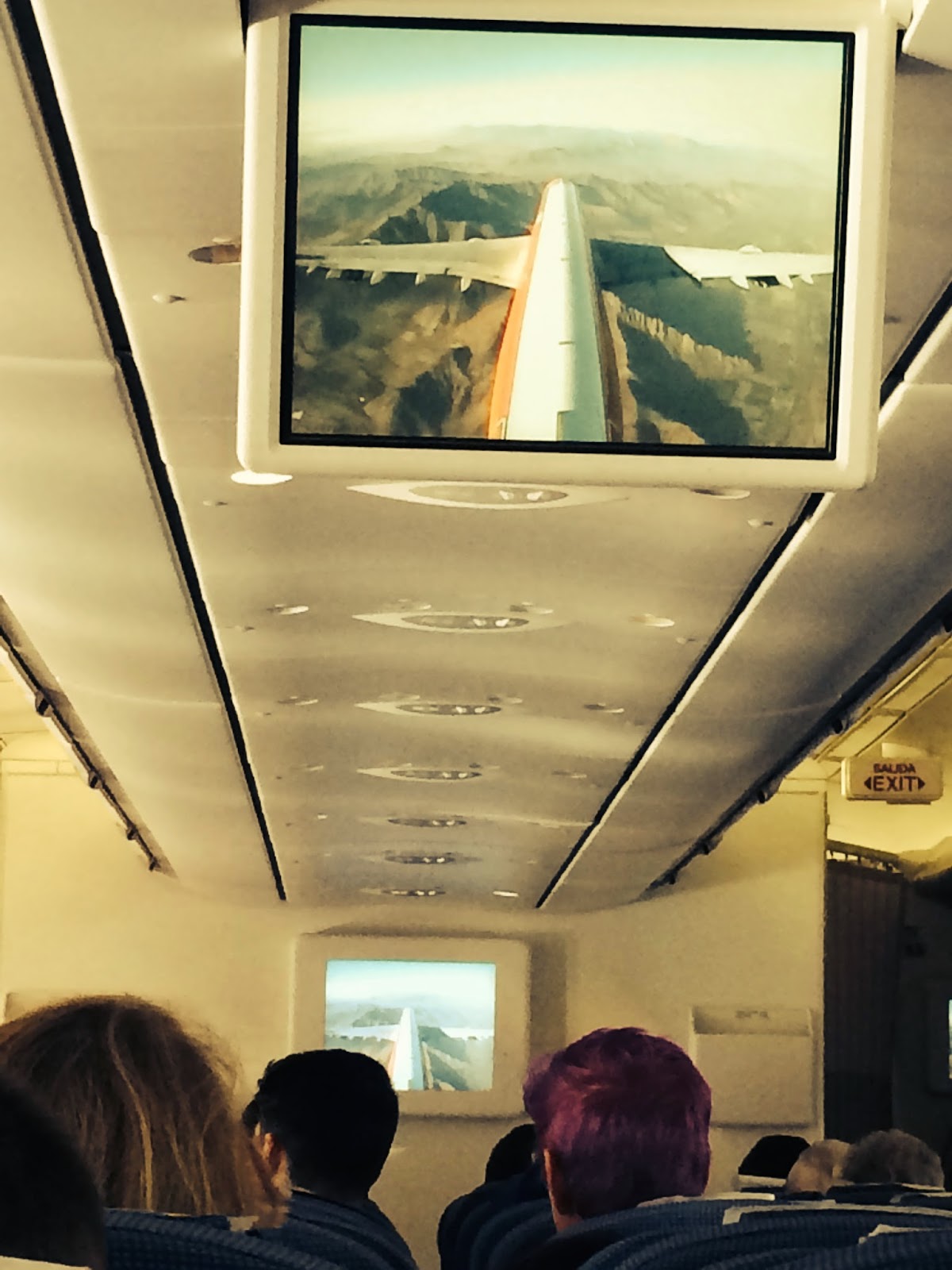
Some 12 hours after leaving Madrid, breakfast is served and the aisles are filled with stretching, weary passengers. Then we realise that the central screens are showing real time film of our approach to Santiago. The Andes appear through snow and mist and ice crystals on the camera lens. Captivated, we watch as the peaks slowly come into view, their majestic, sharp ridges glowing in old rose and burnt siena in front of our eyes. Convincing us that we are indeed having a reality tv experience, the undercarriage comes down, roads, buildings and then the runway come into view. Puffs of white smoke appear as we touch down, the retro thrusters kick in and we begin a slow, graceful progress towards the terminal building.  Passengers break into applause, from enjoyment of the spectacle rather than relief at a safe landing.

Santiago is a stopover en route to our final destination, Stanley in the Falkland Islands – the gateway to the Antarctic. The purpose of the trip is to supervise the construction of the foundation for the memorial to those who lost their lives working in British Antarctic Territory and to make detailed plans for its dedication in February 2015. (See British Antarctic Monument Trust). The bronze and polished steel memorial is itself on its way to Stanley, on board the British Antarctic Survey ship James Clark Ross. 
Finishing touches in the Pangolin foundry before shipping
Our spirits rise when our luggage appears on the conveyor belt intact. The five threaded steel rods, each 500cm long and 16mm diameter, protected by pipe insulation and packed amongst socks, sweaters and shirts, did not set off alarms bells going through security. So it seems we will be able to achieve a key task in the project, embedding the bolts in concrete ready to receive and secure the memorial in its windswept position on Dockyard Point, its tip shining towards the Harbour Narrows. 

Postscript: the women's team taking part in the Homeless Football World Cup had only been playing together for a few days before setting off for Santiago, yet reached the quarter finals before losing to Mexico. The men's team reached the final eight for the first time since joining the competition. Many congratulations to all.