Showing posts with label Women in Property. Show all posts

Sunday, 18 March 2018

Heads up, hands off, move on...


Focus of attention at Cannes? Picture from MIPIM press office
News from Cannes this week that after years of nurturing its reputation as the alcohol and testosterone fuelled event of the international property calendar, the organisers of MIPIM decided to issue a code of conduct for the hosts and delegates flocking to the week-long real estate conference with its fun filled activities on beaches, boats, ballrooms and barstools.  Reed Midem repeatedly warned delegates to respect all individuals and, astonishingly, reminded the 25,000 attendees that “under no circumstances does MIPIM register prostitutes.”


Attending the shindig as a woman has long been recognised as challenging at best and intimidating at worst, with groups including the Association of Women in Property offering survival guides and seminars to its members. Some companies recognise the hazards and try to support female staff. Some women have simply decided not to participate at all, regardless of the perceived impact of not being seen on la croisette. Women including internationally acclaimed architect Amanda Levete CBE for example, who said last month when receiving the Jane Drew prize, “I went to MIPIM once and decided that I would never go again.”

The timing of MIPIM 2018 made it inevitable that the spotlight would fall on its misogynistic reputation. After months of uproar on both sides of the Atlantic over the intimidation and harassment of women in the workplace (Weinstein, Trump, gender pay audits, resignations and accusations in politics and business etc), it was the Presidents’ Club at the Dorchester in London in January that finally made the UK property industry face up to its reputation. As Chris Grigg, chief executive of the UK’s second-biggest property company British Land said, the Presidents Club scandal had revealed the “sleazy underbelly” of the industry and businesses needed to do more to banish unacceptable behaviour and promote diversity and inclusion.

MIPIM took place just a week after an International Women’s Day that was celebrated with particular enthusiasm following months of protest over treatment of women in the workplace around the world combined with the 100th Anniversary of women in Britain first gaining the right to vote.
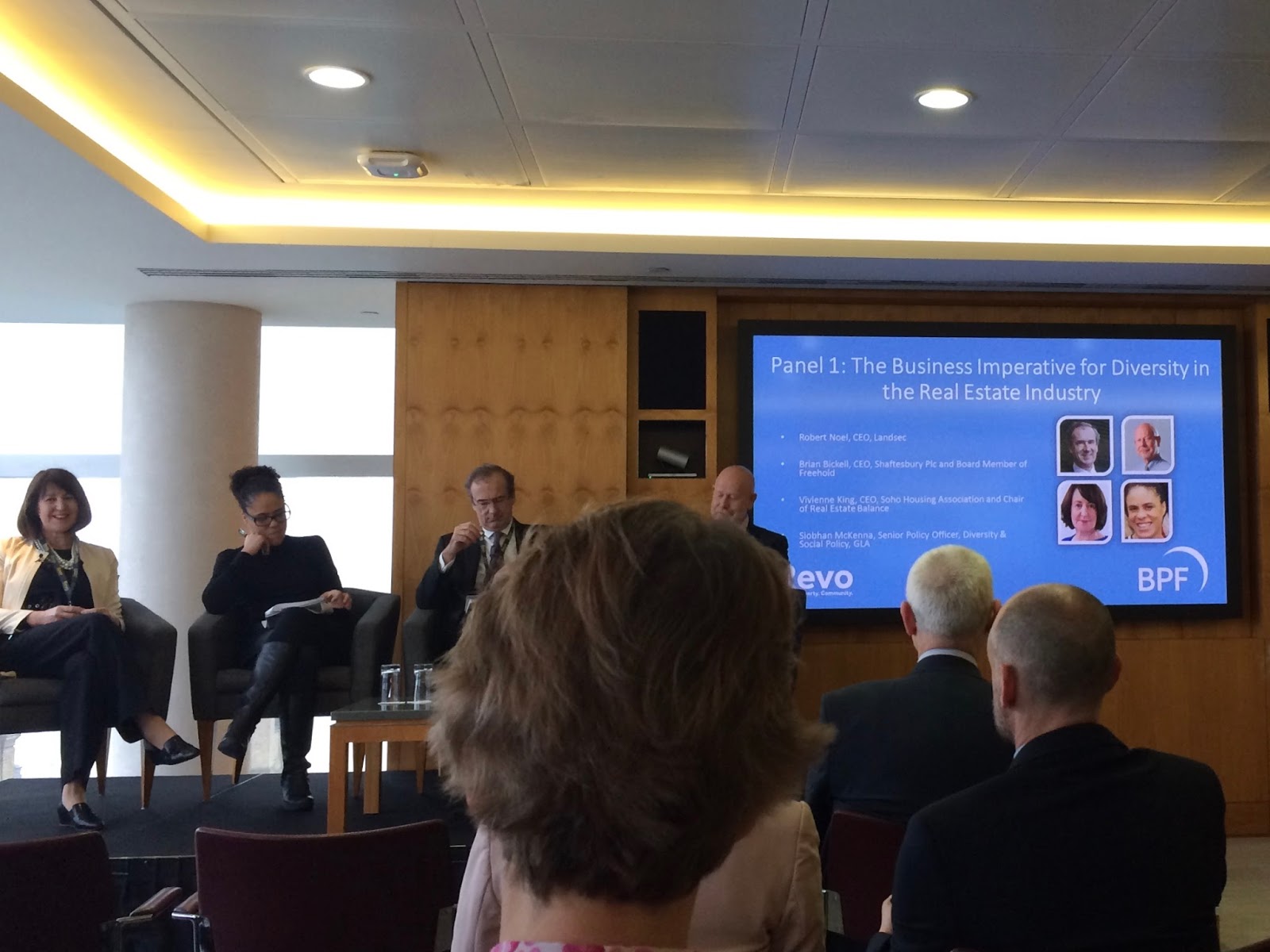
Encouragingly, for an industry claiming to have so few women in its workforce (and certainly one that seems to have difficulty finding them when it comes to jobs in top management and on boards) there were a heck of a lot of women in construction and property making themselves both visible and audible over the past few weeks. From the 500 who gathered to hear Crown Estate’s Alison Nimmo on 14 February at Women leading real estate, to the crowd that turned up for the Opening Doors diversity conference organised by the British Property Federation and Revo on 19 February, to the Inspire Me roundtable organised by Construction News on 1 March, when more than 80 women and men braved the Beast from the East for an 8.00am Monday start.

(Note to the St James Sofitel and other smart London hotels: businesswomen  need somewhere to sit down whilst they swap their rugged weather boots for smart shoes.)

And that’s before the week of events, conferences and the social mediafest that marked International Women’s Day itself. Never before have so many women engineers, contractors, architects, surveyors, planners, housebuilders, crane operators, scaffolders, lawyers, accountants, developers made their presence so confidently and positively felt. There was even a woman civil engineer on Question Time – Roma Agrawal, of Aecom. Just two weeks earlier, we learned that Rachel Skinner of WSP will become not only one of the youngest Presidents of the Institution of Civil Engineers in its 200 year history, but the second woman ever to take on the role.
Rachel Skinner, ICE President Elect
So it is difficult to believe that the female percentage across construction and property remains so stubbornly around 15% (although figures are tricky and it varies across the disciplines), but perhaps it simply confirms my view that we should talk numbers of women, not percentages. After all, in such a large sector, even 15% represents an impressive number of individual women.

So what are the memorable comments that came out of this focus on women in the workplace? It was great to see and hear from a growing number of men both on the platform and in the audience at the various events and here's a selection.

Paul Brundage, President of the British Property Federation, described the President’s Club debacle as an incident that could take the property sector back decades, not to mention the personal embarrassment at explaining what had happened to his teenage daughter when she asked if that was the sort of thing he did. “We have a long way to go,” he said, adding, “It might be behind us for the moment, but we must not hide behind it.”

Brian Bicknell, of Shaftestbury Estates, who highlighted the problems created by Unconscious Bias and the need to campaign in a different way, “through persuasion rather than shouting.” Persistence too, he said, remembering the resistance to his organisation Freehold when first proposed, but now well established.

Alison Nimmo CBE, of Crown Estates, who after telling her audience that the worst boss she ever had couldn’t make decisions, advised them, “Trust your own judgment and just get on with stuff.”

Siobhan McKenna, of the GLA, talked about the Mayor’s commitment to sorting the gender pay gap and, as a mother of three, recognized the challenge that for many women, the cost of childcare can make it difficult to make working affordable.

Beth West, who has recently joined Land Securities as Head of Development London Portfolio from HS2, talked about the importance of understanding the politics of work and how at first, she found the macho behaviour tough. Despite progress, there is still bad behaviour. “A wise person once told me that a corporate culture is the worst behaviour that the CEO will allow,” she says. “So if you’re a C-suite executive, don’t allow the bad behaviour.”

And talking of CEOs, Juliette Stacey of Mabey Holdings shares my long held belief that the changes needed to encourage more women in construction are the changes that will benefit everyone.  “Working practices have been so poor that it’s no wonder many skilled people chose not to return to our sector after the last recession, exacerbating today’s skill shortage,” she says. “Bringing more women into our sector, and ensuring they progress into more senior positions, will be essential if construction is to transform into a better and stronger sector.”
Juliette Stacey, CEO Mabey
Juliette generated a gasp from her Inspire Me audience when recounting how only one man in the boardroom could look her in the eye when she was made CEO. That was only two years ago, but judging by the momentum that is being generated throughout the industry, we may be reaching a “Get over it moment’ for those who don’t believe a woman’s place is at the top of construction or property company.

So what about practical help? Here are some tips.
* mentoring schemes for women at all levels plus reverse mentoring for middle and senior management
* unconscious bias awareness training to improve recruitment, appraisal and retention (we all have UCB, it’s just a question of recognizing and dealing with it)
*  insistence on recruitment companies and headhunters broadening their search for women candidates
* make the most of your NEDs – they should be the critical friends who help change the culture. 

And when it comes to that gender pay gap? Back in 1996, the first recommendation in my report Tomorrow's team: women and men in construction was that the construction industry should lead the way by establishing equal pay for work of equal value. It’s not too late, chaps.


Tuesday, 21 March 2017

You cannot be serious...

Engineers do standup and bring the house down.  
Picture: Engineers without borders 

Listening to ripples of laughter during a memorial service last week leads me to ponder on the power of humour in the vicissitudes of the human condition. We are gathered in the Swedish Church in London’s Marylebone, packed full of family, friends and colleagues, to remember the inimitable Staffan Gadd, a banker who arrived in the UK from Stockholm back in the 1980s to set up a Nordic consortium and who became known in the City as ‘The Viking’ after he became the first so-called foreigner to head an archetypal English institution, the merchant bank Samuel Montagu.

I was introduced to Staffan some years ago by my close friend Pia Helena and it is her eulogy at the memorial which causes much of the fond amusement. Others have already described his ability, ambition and energy for work and play. Pia Helena talks about his charm, enquiring mind, generosity and his enjoyment in female company – raising smiles and nods amongst family and friends. But as she points out, he also appreciated the abilities and potential of women.

It was Staffan who introduced Barbara Thomas (now Lady Barbara Judge) to the British banking world. It was Staffan who proposed that the Swedish Chamber of Commerce should consider appointing a woman Managing Director - Pia Helena was the first and since then the organization has been led by women – and he supported and appointed able women throughout his career. Her recall of Staffan the man is both poignant and very funny, even the recounting of the last words he spoke to her when she and her husband visited him shortly before he died.

After a wonderful lunch (the sort of party Staffan would have approved of, as his widow Kay said) I return home to find that outrage continues unabated on Twitter and LinkedIn over the remarks made by John Allan, Chairman of Tesco about white men becoming an endangered species in UK boardrooms. After reading his comments in detail, rather than headlines and social media rant, I am surprised by the vehement criticism they are generating, and the calls for his resignation and boycotting Tesco stores.

Tesco's John Allan listening thoughtfully
Picture: City am

“If you are female and from an ethnic background, and preferably both, then you are in an extremely propitious period,” the Tesco chairman said to an audience of aspiring women in the retail sector. “For a thousand years, men have got most of these jobs, the pendulum has swung very significantly the other way now and will do for the foreseeable future, I think. If you are a white male, tough. You are an endangered species and you are going to have to work twice as hard.”

Of course, there is a long way to go before women are more fairly represented on boards, including Tesco, both in executive and non executive roles. As more men opt for portfolio careers, the competition for non executive positions grows and it is galling that so many of the posts offered to women are unpaid (and I speak from personal experience) and that the Minister for Women receives no additional salary for the post. But why should a man supporting women at a leadership conference be so pilloried? Surely it is better to welcome a man who is supporting women’s aspiration as an ally, rather than as an enemy.

The real disappointment is that in the furore John Allan felt obliged immediately to defend his remarks by saying they were made in jest, thus diminishing the valid point behind them. He used humour for engagement and emphasis. By the weekend he decides to stand by his comments, describing the reaction as misinterpretation rather than defending them as a joke. He repeats his long held commitment as an advocate of diversity and confirming the need for boards to be active in bringing together a representative set of people.

When I first became involved in promoting gender diversity in the construction industry in the mid 1990s, the very mention of the topic would clear conference halls in seconds or be greeted with a palpable reluctance to engage. My tactics were to have snappy headlines for presentations and to combine hard facts with a sense of humour, making it clear that I was up for a frank and open debate, that unacceptable working conditions for women were equally unacceptable for men, offering some practical ideas and a lighthearted tone rather than po faced political correctness. Sometimes I felt I was walking on eggshells, sometimes the jokes didn’t work (and the toughest audiences could be women) but more often it did. And gradually we have moved from why should we encourage and support more women in construction, to how can we do it.

There is growing evidence that appropriate use of humour creates a better working environment, encourages teamwork, reduces stress and fosters creative thinking. In a study from the American Journal of Applied Psychology, just one use of  humour among work teams not only immediately resulted in improved performance not just immediately but could still be recalled and effective up to two years later. Lynn Taylor author of Tame Your Terrible Office Tyrant believes that employees don’t feel comfortable making jokes around their bosses but that applying intelligent humour to your job can have multiple benefits.

Happy people on a Women in Property site visit

I can vouch for this, after working with standup comedian and psychologist Stephanie Davies of Laughology to develop a Women in Property training programme on recognising and managing Unconscious Bias for global property company Cushman & Wakefield. As we travelled around the UK, it was a revelation to watch how the power of laughter helped reluctant or sceptical managers to understand how their inbuilt biases and reactions affected day-to- day work and decision making. From assessing an applicant for a job to reacting to a client’s request, from defusing a difficult situation to creating an effective team, the positive psychology based in humour and a sense of happiness encourages a sense of perspective and emotional control.

This morning as I read the shocking report from Public Health England revealing that the suicide rate amongst crafts and tradesmen in the industry is nearly four times higher than the national average, the need to look at the culture and wellbeing of all those working in the construction is an imperative – and caring, insightful, approachable management is essential. The Health in Construction Leadership Group launched last year is a step in the right direction, as is the Mates in Mind programme looking at ways of reducing stress and mental illness in the industry.

In all this, there is a place for humour, to break a tension barrier or create a sense of camaraderie, but beware the excuse ‘I’m only kidding’. There is a world of difference between using humour to engage and emphasise and the ‘locker room banter’ excuse used by the 45th President of the US to dismiss criticism of his deeply offensive remarks and behaviour. This same excuse has been used for years to justify offensive remarks and bullying in the construction industry, amongst professionals as well as site workers, affecting men as well as women.

As Stephanie Davies says, a prime focus of any organisation and its teams should be wellbeing and engagement. If you are happy in your work and have the coping skills and resilience to face challenges, you are less likely to take time off and more likely to get the job done, give discretionary effort and be positive. The Royal Academy of Engineering is funding training in standup comedy for young men and women engineers, and their performances certainly bely the old joke that Civil Engineering comes after Boring. Well worth taking a look at the Engineering Showoff site. 
So I will carry on using snappy headlines, a light touch when training and expect laughter within fifteen minutes at board meetings and conferences.